
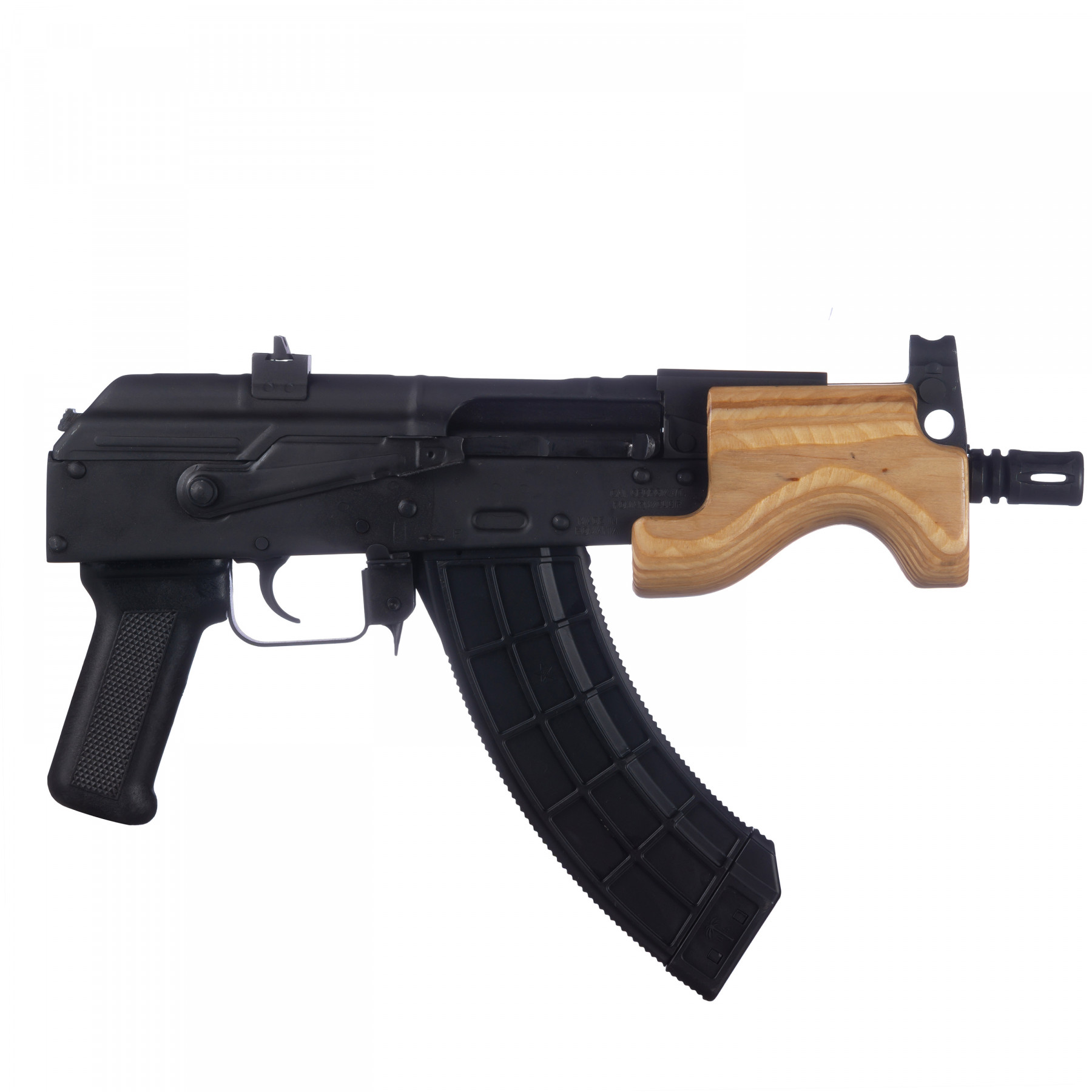












Micro Draco AK-47 Pistol, Semi-Automatic, 7.62 x 39mm, 6.25" Barrel, 30 1 Rounds Buy at affordable price
$ 92.03
Micro Draco Mini DRACO semi automatic pistol from century Arms , features a 7.75 Chrome-Lined. Each pistol comes with 30-Round magazine Manufacture ; Century Arms Model; Min DRACO Caliber; 7.62(39) Finish; Black Barrel Length; 7.75 Chrome Lined Barrel Magazine Capacity;30 Twist Rate; 1;10* Overall Length ; 17.5* Weigth 5.6 lbs Barrel 1:10 twist 14×1 LH thread. Stamped receiver Accepts all standard AK magazines Comes with one 30 round standard capacity magazine. During World War II, the Sturmgewehr 44 rifle used by German forces made a deep impression on their Soviet counterparts.[10][11] The select-fire rifle was chambered for a new intermediate cartridge, the 7.92×33mm Kurz, and combined the firepower of a submachine gun with the range and accuracy of a rifle.[12][13] On 15 July 1943, an earlier model of the Sturmgewehr was demonstrated before the People’s Commissariat of Arms of the USSR.[14] The Soviets were impressed with the weapon and immediately set about developing an intermediate caliber fully automatic rifle of their own,[10][11] to replace the PPSh-41 submachine guns and outdated Mosin–Nagant bolt-action rifles that armed most of the Soviet Army.[15] The Soviets soon developed the 7.62×39mm M43 cartridge, which is used in[14] the semi-automatic SKS carbine and the RPD light machine gun.[16] Shortly after World War II, the Soviets developed the AK-47 rifle, which quickly replaced the SKS in Soviet service.[17][18] Introduced in 1959, the AKM is a lighter stamped steel version and the most ubiquitous variant of the entire AK series of firearms. In the 1960s, the Soviets introduced the RPK light machine gun, an AK type weapon with a stronger receiver, a longer heavy barrel, and a bipod, that eventually replaced the RPD light machine gun.[16] Concept Mikhail Kalashnikov began his career as a weapon designer in 1941 while recuperating from a shoulder wound which he received during the Battle of Bryansk.[5][19] Kalashnikov himself stated…”I was in the hospital, and a soldier in the bed beside me asked: ‘Why do our soldiers have only one rifle for two or three of our men, when the Germans have automatics?’ So I designed one. I was a soldier, and I created a machine gun for a soldier. It was called an Avtomat Kalashnikova, the automatic weapon of Kalashnikov—AK—and it carried the year of its first manufacture, 1947.”[20] The AK-47 is best described as a hybrid of previous rifle technology innovations. “Kalashnikov decided to design an automatic rifle combining the best features of the American M1 and the German StG 44.”[21] Kalashnikov’s team had access to these weapons and had no need to “reinvent the wheel”. Kalashnikov himself observed: “A lot of Russian Army soldiers ask me how one can become a constructor, and how new weaponry is designed. These are very difficult questions. Each designer seems to have his own paths, his own successes and failures. But one thing is clear: before attempting to create something new, it is vital to have a good appreciation of everything that already exists in this field. I myself have had many experiences confirming this to be so.”[19] There are claims about Kalashnikov copying other designs, like Bulkin’s TKB-415[22] or Simonov’s AVS-31.[23] Early designs Kalashnikov started work on a submachine gun design in 1942[24] and with a light machine gun design in 1943.[25][26] Early in 1944, Kalashnikov was given some 7.62×39mm M43 cartridges and was informed that there were other designers working on weapons for this new Soviet small-arms cartridge. It was suggested that a new weapon might well lead to greater things. He then undertook work on the new rifle.[27] In 1944, he entered a design competition with this new 7.62×39mm, semi-automatic, gas-operated, long stroke piston carbine, strongly influenced by the American M1 Garand.[28] This new rifle was in the same class as the SKS-45 carbine, with a fixed magazine and a gas tube above the barrel.[27] However, the new Kalashnikov design lost out to a Simonov design.[29] In 1946, a new design competition was initiated to develop a new rifle.[30] Kalashnikov submitted an entry. It was gas-operated rifle with a short-stroke gas piston above the barrel, a breech-block mechanism similar to his 1944 carbine, and a curved 30-round magazine.[31] Kalashnikov’s rifles AK-1 (with a milled receiver) and AK-2 (with a stamped receiver) proved to be reliable weapons and were accepted to a second round of competition along with other designs. These prototypes (also known as the AK-46) had a rotary bolt, a two-part receiver with separate trigger unit housing, dual controls (separate safety and fire selector switches) and a non-reciprocating charging handle located on the left side of the weapon.[31][32] This design had many similarities to the StG 44.[33] In late 1946, as the rifles were being tested, one of Kalashnikov’s assistants, Aleksandr Zaitsev, suggested a major redesign to improve reliability. At first, Kalashnikov was reluctant, given that their rifle had already fared better than its competitors. Eventually, however, Zaitsev managed to persuade Kalashnikov. In November 1947, the new prototypes (AK-47s) were completed. It used a long-stroke gas piston above the barrel. The upper and lower receivers were combined into a single receiver . The selector and safety were combined into a single control-lever/dust-cover on the right side of the rifle. And, the bolt-handle was simply attached to the bolt-carrier. This simplified the design and production of the rifle. The first army trial series began in early 1948.[34] The new rifle proved to be reliable under a wide range of conditions with convenient handling characteristics. In 1949, it was adopted by the Soviet Army as “7.62 mm Kalashnikov rifle (AK)”.[9